CASHFLOW ARCHITECTURE BRIEFING // SEASON 1, EPISODE 12 EXECUTIVE INTELLIGENCE BRIEFING
GOOGL 5/14 ACTIVE GATES

What does Google Really Sell?

In 1998, dominant web portals Yahoo, Lycos, and Excite believed the objective of a search engine was to trap users on cluttered homepages with horoscope widgets, weather badges, and flashing banner ads. Larry Page and Sergey Brin realized that a search engine should do the exact opposite: dispatch users to their destination as fast as humanly possible. The world assumes Google makes money by providing a free search engine, free Android software, and YouTube videos. That is what is SEEN.

LIVE MATRIX PREVIEW
THE 7 MONEY GATES™ INTERACTIVE CANVAS

Want to skip the story and explore the interactive matrix showing all the gates this brand uses?

Test your commercial intuition: click to reveal the unseen cash engines, explore all 14 physical & digital gates, and see the exact mechanics this enterprise uses to extract profit.

FORENSIC CASE STUDY

The Architecture of Alphabet's Search Monopoly

ACT I // THE INCUMBENT BLUNDER 01

The Portal Prison Myth

Back in 1998, the dominant kings of the early internet—Yahoo, Excite, Lycos, and AltaVista—were completely obsessed with a metric called 'stickiness.' Their corporate strategy was simple: trap visitors on cluttered portal homepages loaded with celebrity gossip, weather widgets, stock tickers, and flashing display banners. The longer a user lingered on the page, the more banner impressions the portal could bill.

Because of that mindset, portal executives viewed search engines as a dangerous liability. Why? Because a great search engine helped users leave the homepage immediately. When Larry Page and Sergey Brin tried to license their PageRank algorithm to Yahoo for $1 Million in 1998, and later offered to sell Google to Excite for just $750,000, both were flatly rejected.

Incumbents simply couldn't fathom that a stark, empty white page with a single text box could ever make a dime—let alone become the most lucrative commercial toll road in economic history.

"Search is an incidental feature. If we make search too good, users leave our page, and our banner ad impressions plummet."

— Dot-Com Era Portal Executive Consensus (1998–1999)
ACT II // THE STRUCTURAL COUP 02

Monetizing Human Intent & The Android Trojan

Google didn't invent search advertising; Goto.com (later Overture) did. But Google perfected its financial mechanics with AdWords in 2002. Instead of selling static banner real estate or allowing the highest bidder to buy the top rank with irrelevant junk, Google paired an automated Vickrey auction with an algorithmic 'Quality Score.'

This meant advertisers only paid when an active human actually clicked (Cost-Per-Click), and ads had to be directly relevant to the user's explicit query. For the first time in human history, advertising wasn't an annoying interruption broadcast to passive viewers; it was a targeted answer served to someone actively searching for a solution with their credit card in hand.

Then in 2005, Eric Schmidt executed a quiet masterclass in defensive distribution: Google acquired a 22-person mobile startup called Android for $50 Million. Schmidt saw the writing on the wall: if computing moved from desktops to pocket phones, cellular carriers and Microsoft would lock Google out of the mobile web. By giving Android away for free to every global handset manufacturer, Google turned the global smartphone fleet into a permanent telemetry network—guaranteeing search remained the default tollbooth for billions of mobile humans.

ACT III // THE UNSEEN CASH ENGINES 03

The Three Tollbooths Funding Alphabet's $2 Trillion Valuation

Most consumers perceive Google as a benevolent provider of free consumer software—Search, Maps, Gmail, Chrome, and YouTube. In truth, every free utility is a data and attention funnel feeding Alphabet's high-margin monetization tollbooths.

THE UNSEEN TOLLBOOTHS

How The Cash Actually Moves

01 Attention Gate
The Real-Time Search Intent Auction

Google Search is not a public library; it is a split-second automated auction house. When a user searches for 'commercial insurance' or 'best mesothlioma lawyer', companies bid up to $100+ for a single click. Furthermore, global brands are compelled to bid tens of millions annually on their own trademarked brand names just to stop competitors from poaching top placement above their organic links.

FORENSIC METRIC $224.5B / Year (80%+ Margin)
Source: Alphabet FY2025 Form 10-K Search Segment
02 Services Gate
Google Cloud Platform (GCP) Infrastructure Leases

The immense planetary computing, TPU machine learning clusters, and fiber networks originally built to index the world's web pages are now rented out to global corporations, financial institutions, and AI startups on a meter. Google Cloud has transformed from a capital expenditure sink into an annualized $62B+ enterprise profit engine.

FORENSIC METRIC $62.6B Annual Cloud Run Rate
Source: Alphabet FY2025 Segment Disclosures
03 Money Gate
The Google Play Android Border Tax

Google gave away the Android operating system for free to Samsung, Xiaomi, and dozens of OEMs, but retained unilateral control over the Google Play Services layer. Every mobile developer distributing software or selling digital in-app goods on Android must surrender a 15% to 30% transaction toll on every purchase.

FORENSIC METRIC 15% - 30% App Distribution Levy
Source: Google Play Store Platform Developer Agreements
THE SEEN ENGINE
$12.00B

Pixel & Nest Device Hardware

The estimated gross retail sales of Google Pixel smartphones, Pixel Watches, and Nest smart home devices.

Source: Analyst Estimates, grouped inside Alphabet's $48.0B Subscriptions, Platforms & Devices segment
THE UNSEEN ENGINE
$387.81B

Ad Network, Cloud, Play Store Tolls & Subscriptions

The high-margin combined revenues generated from Google Search ads ($224.5B), YouTube advertising ($40.4B), Google Network partner ads ($29.8B), Google Cloud ($62.6B), plus Google Play Store commissions and consumer subscriptions (YouTube Premium, Google One) within the non-hardware portion of the platforms segment.

Source: Alphabet FY 2025 Form 10-K

The real wealth is in what is NOT SEEN—how Google transformed human intent into the most lucrative commercial auction in economic history, extracting over $237B in high-margin advertising tolls by forcing global brands to bid against their own names in automated split-second auctions, while paying $20B+ annually to Apple just to secure default tollbooth placement.

But which money gates does Google (Alphabet Inc.) use to stack this cashflow? Click each ? to reveal how they use that gate.

AGENT // PROFIT OPENER THE SEEN (PHYSICAL/DIGITAL) THE UNSEEN (PHYSICAL/DIGITAL)
1. Products
ACTIVE · SEEN Google Pixel & Nest Hardware Manufacturing and selling physical consumer devices like Pixel smartphones, Pixel Watches, and Nest smart home utilities. Source: Alphabet Inc. FY2024 Form 10-K, Google Other (Hardware & Devices) Disclosures
—
2. Services —
3. Access —
4. Attention —
5. Money —
6. Risk — —
7. Brand — —
STEP 03

Strategic Translation

The underlying economic infrastructure driving this profit extraction design.

01

What is the explicit promise the customer buys?

A clean web search bar, Android mobile phones, YouTube video streaming, and Google Maps.

02

What asset is quietly accumulating as a result?

Over 90% share of the global web search market and billions of active Android devices worldwide acting as permanent telemetry and ad-distribution endpoints.

STEP 04

Boardroom Strategy Takeaway

Commercial architecture analysis & operational directives for executive decision-makers.

PO
EXECUTIVE STRATEGY TAKEAWAY

Turn your core software utility or operating system into a free, indispensable consumer tool to aggregate massive, global user attention. Once you own the attention gateway, monetize it by charging advertisers for targeted exposure (Attention), charging developers a percentage commission to access your platform's users (Money), leasing your background processing infrastructure (Services), and upselling premium feature subscriptions (Access).

FOR SMEs & OPERATORS Pragmatic Implementation

Prerequisite Condition: Use this when you can build a software utility with near-zero marginal distribution costs that solves a daily workflow problem for hundreds of millions of users.

Actionable Blueprint: A local real estate information website provides a free local property tax and valuation calculator (Services - Digital) to become the go-to tool for local homebuyers, but makes its profits by selling sponsored advertising placements to local real estate agents (Attention - Digital) and charging agents a referral transaction commission on client introductions (Money - Digital).

📖 VIEW THE 14 PROFIT OPENERS FRAMEWORK GUIDE ▼
THE FRAMEWORK // FOR REFERENCE

The 14 Profit Openers Explained

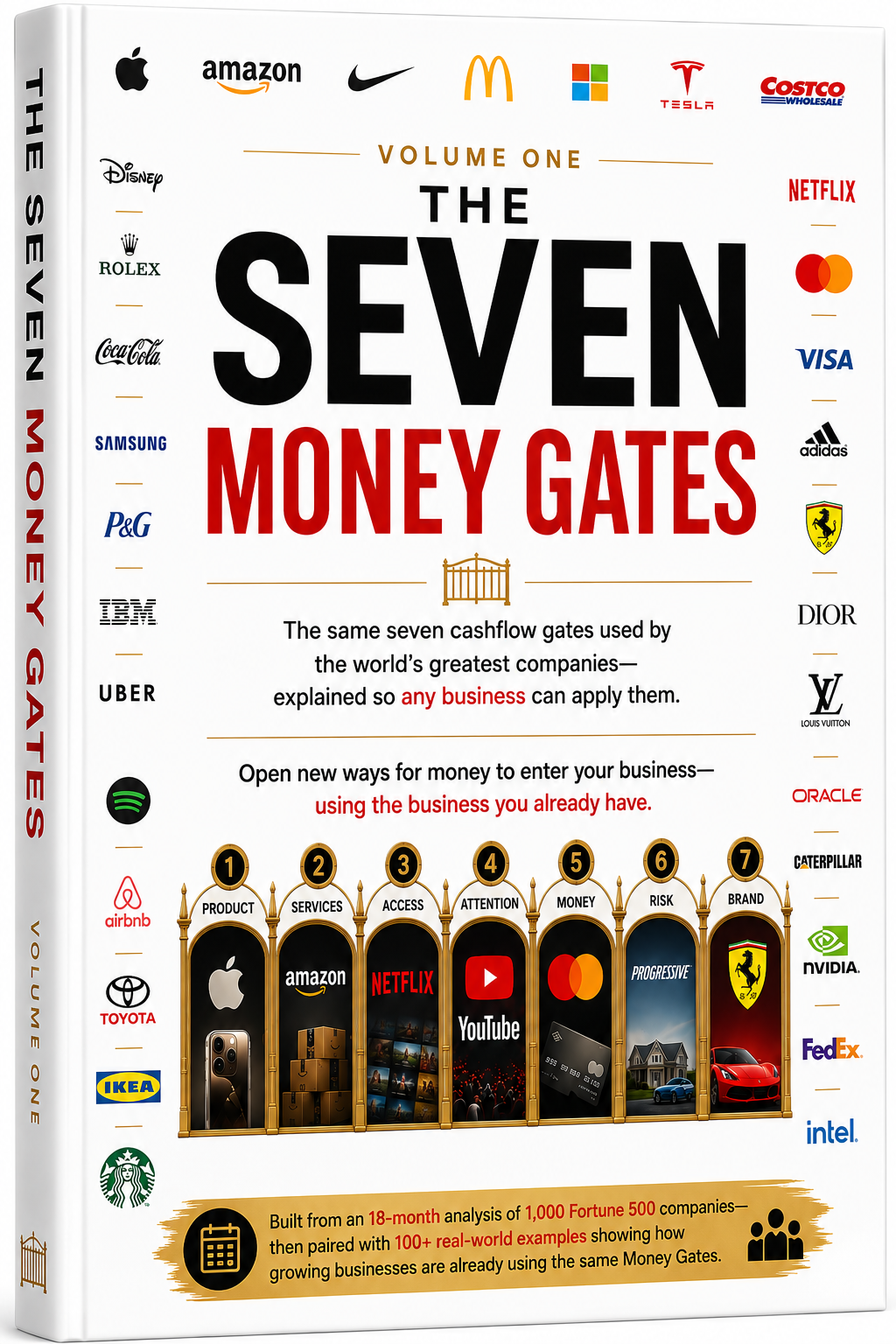
Every business extracts revenue through some combination of these 14 channels — 7 openers, each available in a Physical and a Digital medium. Use this as your reading guide.

PROFIT OPENER PHYSICAL CHANNEL DIGITAL CHANNEL
01 Products Physical Product Sales Tangible goods manufactured, packaged, and sold via retail or direct channels. The classic storefront transaction. Digital Product Sales Downloadable assets, software, templates, or digital files sold as a one-time purchase with zero delivery cost.
02 Services Physical Service Delivery In-person labor, consultations, repairs, or expertise delivered at a physical location or on-site. Digital Service Delivery Remote consulting, virtual coaching, online fulfillment, or any service rendered and delivered through digital channels.
03 Access Physical Access Gate Memberships, entry passes, physical loyalty tiers, or location-based access privileges privileges sold on a recurring basis. Digital Access Gate Subscription plans, SaaS tiers, paywalls, or recurring digital membership fees that gate content or functionality.
04 Attention Physical Attention Capture Billboard placements, event sponsorships, in-store brand shelving, or any physical advertising inventory sold to third parties. Digital Attention Capture Ad revenue, sponsored placements, affiliate arbitrage, or monetizing an owned audience's attention through digital channels.
05 Money Physical Money Mechanics Upfront payment collection, deposit structures, or float optimization — holding cash from physical transactions before fulfillment. Digital Money Mechanics Payment processing spreads, digital float, BNPL integrations, or fintech revenue extracted from digital transaction flow.
06 Risk Physical Risk Coverage Extended warranties, in-store protection plans, insurance products, or physical asset guarantees sold alongside the core product. Digital Risk Coverage Digital warranties, SLA upsells, cybersecurity add-ons, or data backup subscriptions that monetize a customer's fear of loss.
07 Brand Physical Brand Licensing Trademark royalties, franchise licensing fees, co-branding deals, or physical branded merchandise sold to third parties. Digital Brand Licensing IP licensing, white-label software deals, digital co-branding arrangements, or platform platform placement fees paid for brand association.