CASHFLOW ARCHITECTURE BRIEFING // SEASON 1, EPISODE 17 EXECUTIVE INTELLIGENCE BRIEFING
NASA 3/14 ACTIVE GATES

What does NASA Really Sell?

During the Cold War, space exploration was viewed as an ideological taxpayer sinkhole with zero direct commercial return. NASA inverted this paradigm by creating the Technology Transfer Program, spinning off thousands of federally-funded aerospace patents into private industry. The world assumes NASA makes its impact solely through astronaut missions to Mars and deep space satellite telescopes. That is what is SEEN.

LIVE MATRIX PREVIEW
THE 7 MONEY GATES™ INTERACTIVE CANVAS

Want to skip the story and explore the interactive matrix showing all the gates this brand uses?

Test your commercial intuition: click to reveal the unseen cash engines, explore all 14 physical & digital gates, and see the exact mechanics this enterprise uses to extract profit.

FORENSIC CASE STUDY

The Architecture of the Federal Space Commercialization Machine

ACT I // THE INCUMBENT BLUNDER 01

The Cold War Defense Sinkhole

Throughout the early decades of the Space Race, Washington viewed space exploration as a bottomless geopolitical expense account. Billions in taxpayer treasure were poured into disposable Saturn V boosters, liquid-hydrogen fuel tanks, and titanium heat shields, all justified solely by ideological supremacy over the Soviet Union.

Critics and budget hawks routinely attacked NASA as an economic deadweight—arguing that burning billions of dollars on lunar orbiters while American cities deteriorated was fiscal lunacy. Legacy defense agencies operated on rigid, classified silos: research developed for military rockets was locked in government vaults, classified under national security seals, and left to rot after single missions without generating a dime of commercial utility.

"The primary objective was not to reach the moon, but to master space and develop the operational capacity for the United States to operate in this new environment."

— James E. Webb, Second Administrator of NASA
ACT II // THE STRUCTURAL COUP 02

The 1958 Space Act Mandate & The Spinoff Engine

Buried inside Section 203 of the National Aeronautics and Space Act of 1958 lay an extraordinary legislative directive: NASA was legally mandated to 'provide for the widest practical and appropriate dissemination of information concerning its activities and the results thereof.'

Rather than hoarding aerospace patents behind bureaucratic red tape, NASA converted public-funded R&D into a commercial engine. In the 1990s, when Jet Propulsion Laboratory scientist Eric Fossum sought to miniaturize cameras for interplanetary exploration, NASA invented the CMOS active pixel sensor. Instead of keeping the sensor classified, NASA licensed the patent to commercial developers—giving birth to the multi-billion-dollar camera module industry that now sits inside every iPhone, Android, and digital camera on earth.

Simultaneously, NASA transitioned from operating expendable state-owned launch systems to becoming the master landlord and certification gatekeeper of commercial spaceflight. Under Space Act Agreements, NASA leased historic launchpads to private startups like SpaceX, offloading hundreds of millions in maintenance liabilities while anchoring the entire commercial space industry.

ACT III // THE UNSEEN CASH ENGINES 03

The Three Tollbooths Powering NASA's Commercial Influence

The public tracks rover landings on Mars and astronaut spacewalks on live video feeds. Behind the scientific prestige, NASA operates a massive technology licensing bank, a gated launchpad real estate portfolio, and an inescapable aerospace mission certification monopoly.

THE UNSEEN TOLLBOOTHS

How The Cash Actually Moves

01 Brand Gate
Technology Transfer & Commercial Patent Licensing

NASA maintains a portfolio of over 1,400 active patents covering advanced materials, water purification, optical diagnostics, and telemetry software. Through its Technology Transfer Program, NASA licenses these technologies to private commercial firms under non-exclusive and exclusive royalties, generating over $180 Billion in cumulative private sector market value.

FORENSIC METRIC 1,400+ Active Commercial Patents / $180B+ Market Value
Source: NASA Technology Transfer Program Annual Spin-Off Reports & Patent Disclosures
02 Access Gate
Historic Spaceport & Launchpad Infrastructure Leases

Under Section 308 of the National Aeronautics and Space Act, NASA acts as a commercial aerospace landlord. It leased Historic Launch Complex 39A (the Apollo 11 and Shuttle pad) to SpaceX under a 20-year exclusive commercial lease, and Pad 41 to United Launch Alliance, collecting facility fees while shifting capital maintenance costs to private operators.

FORENSIC METRIC 20-Year Commercial Operating Leases at KSC
Source: NASA Space Act Agreements, Kennedy Space Center Complex 39A Commercial Lease
03 Services Gate
Human Spaceflight Mission Certification & Testing Services

Before any private capsule or booster can dock with the International Space Station or transport astronauts, it must pass NASA's rigorous commercial crew qualification pipeline. NASA charges commercial aerospace contractors for testing chamber access, wind tunnel hours, and formal human-rating certifications.

FORENSIC METRIC $8B+ Commercial Crew Certification Programs
Source: NASA Commercial Crew Program Milestone Reviews & GAO Federal Audit Reports
THE SEEN ENGINE
$24.88B

Federal Budget Appropriations

The direct taxpayer funding allocated annually by the U.S. Congress to fund space exploration, aeronautics, and scientific research.

Source: NASA FY2024 Congressional Budget Justification
THE UNSEEN ENGINE
$180.00B+

Commercial Value of Spin-Off Technologies

The estimated commercial economic value generated by private enterprises using licensed NASA patents, technology transfers, and spinoff inventions.

Source: NASA Technology Transfer Program & Federal Laboratory Consortium Reports

The real wealth is in what is NOT SEEN—how NASA functions as an intellectual property licensing engine and commercial procurement authority, licensing patents for CMOS camera sensors, memory foam, and solar cells to private enterprise while dictating multi-billion-dollar aerospace specifications to defense contractors.

But which money gates does NASA use to stack this cashflow? Click each ? to reveal how they use that gate.

AGENT // PROFIT OPENER THE SEEN (PHYSICAL/DIGITAL) THE UNSEEN (PHYSICAL/DIGITAL)
1. Products — —
2. Services
ACTIVE · SEEN Space Flight Certification & Testing Vetting, testing, and formally certifying commercial spacecraft (SpaceX Crew Dragon, Boeing Starliner) for human spaceflight operations. Source: NASA Commercial Crew Program Milestone Reviews & GAO Federal Audit Reports
—
3. Access —
4. Attention — —
5. Money — —
6. Risk — —
7. Brand —
STEP 03

Strategic Translation

The underlying economic infrastructure driving this profit extraction design.

01

What is the explicit promise the customer buys?

Launchpad rocket liftoffs, deep space rover photos, astronaut helmets, and space telescopes.

02

What asset is quietly accumulating as a result?

Over 1,400 active patents, advanced aerospace test facilities, cleanrooms, and launchpad infrastructure.

STEP 04

Boardroom Strategy Takeaway

Commercial architecture analysis & operational directives for executive decision-makers.

PO
EXECUTIVE STRATEGY TAKEAWAY

Leverage project-funded research and development to build a proprietary intellectual property (IP) library (Brand - Digital). Instead of treating custom engineering or R&D as a one-time project service, structure your contracts so that you retain the patent, software code, or blueprint rights, and then license those spin-offs to commercial markets as a high-margin product.

FOR SMEs & OPERATORS Pragmatic Implementation

Prerequisite Condition: Use this when you do custom client project work where the client pays for development, but you can negotiate to retain the rights to the underlying technology components.

Actionable Blueprint: A custom software consultancy gets paid $100,000 by a healthcare company to build a custom patient scheduling algorithm. In the contract, the consultancy retains the IP rights to the generic scheduling engine while giving the client an exclusive license for the health sector. The consultancy then packages the generic scheduling engine as a standard API and licenses it to 50 logistics, retail, and education firms for $500/month, turning custom contract work into a scalable, high-margin software asset.

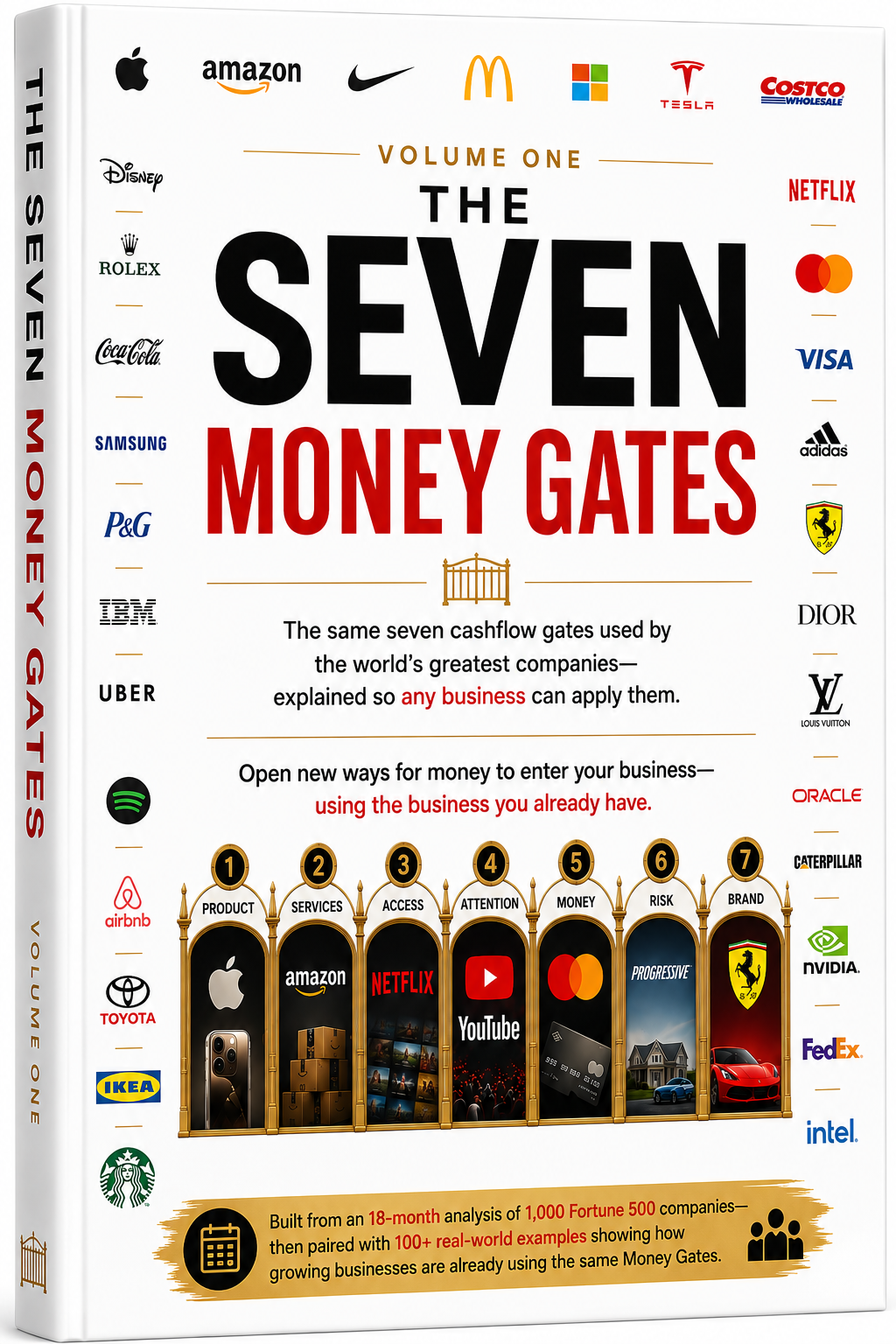
📖 VIEW THE 14 PROFIT OPENERS FRAMEWORK GUIDE ▼
THE FRAMEWORK // FOR REFERENCE

The 14 Profit Openers Explained

Every business extracts revenue through some combination of these 14 channels — 7 openers, each available in a Physical and a Digital medium. Use this as your reading guide.

PROFIT OPENER PHYSICAL CHANNEL DIGITAL CHANNEL
01 Products Physical Product Sales Tangible goods manufactured, packaged, and sold via retail or direct channels. The classic storefront transaction. Digital Product Sales Downloadable assets, software, templates, or digital files sold as a one-time purchase with zero delivery cost.
02 Services Physical Service Delivery In-person labor, consultations, repairs, or expertise delivered at a physical location or on-site. Digital Service Delivery Remote consulting, virtual coaching, online fulfillment, or any service rendered and delivered through digital channels.
03 Access Physical Access Gate Memberships, entry passes, physical loyalty tiers, or location-based access privileges privileges sold on a recurring basis. Digital Access Gate Subscription plans, SaaS tiers, paywalls, or recurring digital membership fees that gate content or functionality.
04 Attention Physical Attention Capture Billboard placements, event sponsorships, in-store brand shelving, or any physical advertising inventory sold to third parties. Digital Attention Capture Ad revenue, sponsored placements, affiliate arbitrage, or monetizing an owned audience's attention through digital channels.
05 Money Physical Money Mechanics Upfront payment collection, deposit structures, or float optimization — holding cash from physical transactions before fulfillment. Digital Money Mechanics Payment processing spreads, digital float, BNPL integrations, or fintech revenue extracted from digital transaction flow.
06 Risk Physical Risk Coverage Extended warranties, in-store protection plans, insurance products, or physical asset guarantees sold alongside the core product. Digital Risk Coverage Digital warranties, SLA upsells, cybersecurity add-ons, or data backup subscriptions that monetize a customer's fear of loss.
07 Brand Physical Brand Licensing Trademark royalties, franchise licensing fees, co-branding deals, or physical branded merchandise sold to third parties. Digital Brand Licensing IP licensing, white-label software deals, digital co-branding arrangements, or platform platform placement fees paid for brand association.