You spend years learning something useful.
Then you put part of it on your website.
An explanation. A comparison. A guide that answers a question your customers keep asking.
Someone finds it, reads it and leaves knowing something they did not know before.
Perhaps they come back. Perhaps they remember you when they need help. Perhaps that page becomes the reason they choose your business.
That is one familiar way to think about publishing your knowledge.
Give people something useful. Let the right people find you.
But what if the next visitor has a different reason for coming?
It is not considering your service.
It will never book a call.
It is a machine requesting your content.
What arrangement should apply then?
One page. A different visitor.
On 1 July 2025, Cloudflare announced a private beta called Pay Per Crawl.
The proposal was simple: let website owners set a price for selected AI crawlers to access their content.
An ordinary reader could still arrive under the site's usual terms. A crawler selected for charging could encounter a payment requirement.
The page did not need to become a different page.
The commercial arrangement around entering it could change.
That is the decision worth stopping for.
Because many business owners have learned to look at their published knowledge from only one direction.
Will it bring traffic?
Will the traffic bring enquiries?
Will an enquiry become a sale?
Those are useful questions. They follow one possible route from the page to a customer.
But another visitor may already have a use for the page itself.
And if you only value the page by how many enquiries it produces, that use can remain outside your commercial thinking.
The request can meet a price.
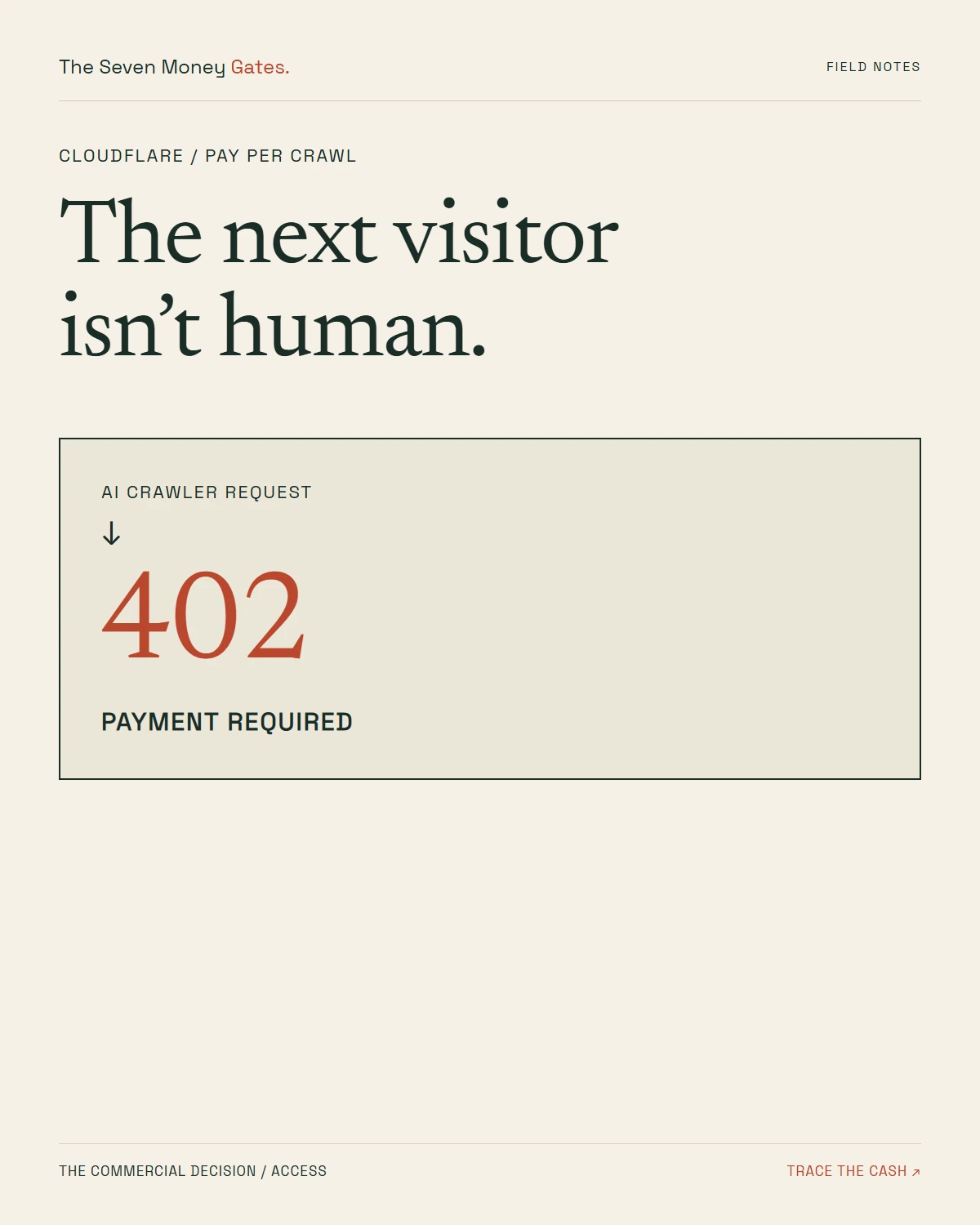
Cloudflare's documentation describes a payment mechanism for participating crawlers. A content request can receive an HTTP 402 response: Payment Required.
In plain language: there is a price for this access.
Its documentation still describes the programme as a closed beta when checked in November 2026.
The interesting part is the arrangement it makes possible.
Someone has a resource. Another party wants to use it. The owner can offer access on defined terms.
Look at that through The Seven Money Gates and the Access Gate becomes easier to recognise.
A building can charge someone to enter and use the space.
A digital library can charge someone to enter and use its collection.
A website can also contain a resource whose access has value to a particular user.
Physical or digital, the question follows the exchange: what is the person paying to use?
Further rights to reproduce or reuse the material need their own terms. Getting through the door and having permission to do anything you want inside are different arrangements.
What have you already made useful?
Imagine a consultant who helps food businesses understand packaging suppliers.
Over time, she builds a carefully maintained directory. It includes the materials each supplier handles, minimum order quantities, lead times and the kinds of businesses they serve.
At first, the directory helps her do her own work.
Then she publishes a few comparisons to help prospective clients understand their options.
Now consider a growing food brand that needs to consult the full directory repeatedly.
It may not want to hire her for every search. It may want continuing access to a useful resource she already maintains.
That is a different offer from paying her to carry out a supplier search.
One arrangement buys her work on a particular problem.
Another could buy access to the resource, within agreed limits, while the brand does its own work.
The directory would need to stay useful. The information would need to be hers to provide. The customer would need a reason to return.
But she can test that offer without pretending the only things she knows how to sell are a report and more consulting hours.
This is an imagined business example. It shows the question the Cloudflare decision brings into view.
What are people repeatedly trying to reach, consult or use around your business?
Have you made an offer for that need?
Free for one purpose does not answer every other purpose.
You may choose to let people read a useful article without paying.
That can be a deliberate part of how they discover you.
You can still examine whether a different user, a different resource or a different level of use needs a different arrangement.
The work is in understanding what they need access to, why it matters and what you can reliably provide.
That is a more useful starting point than deciding every page needs a paywall.
Cloudflare's move gives us a concrete reason to look again at a familiar object: the website.
We often ask what it can help us sell.
There is another question worth asking beside it.
What is already there that someone could pay to use?
Explore the wider Money Gate map ↗
Sources and context
The story follows the July 2025 private-beta announcement. Cloudflare’s documentation still described Pay Per Crawl as a closed beta when checked on 13 November 2026. The packaging consultant is an imagined example. The gate mapping is Pelumi’s analysis.