A machine is something you can point at.
It occupies space. It has a price. A buyer can inspect it, purchase it and put it to work.
That makes ownership feel like the end of the commercial question.
But look at what a modern machine may contain.
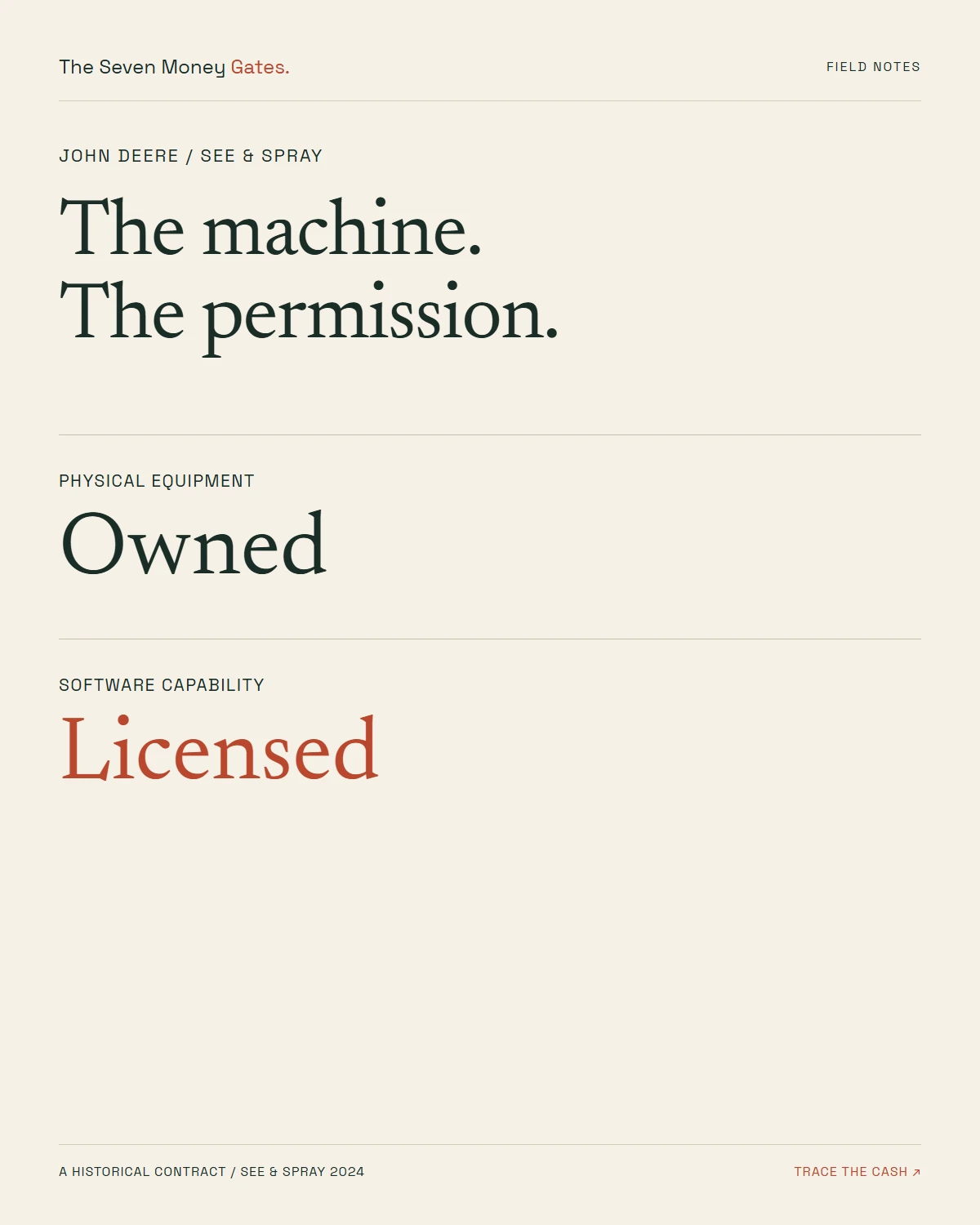
There can be physical equipment and a software capability running on that equipment.
The arrangements around them do not have to end at the same place.
John Deere's See & Spray 2024 license makes that distinction unusually easy to see.
The permission has its own terms.
The agreement covers activation of software features on compatible equipment.
It uses license units that are consumed as the features are used. Consumption is measured by acre-pass and varies by crop.
The contract also describes a further agreement when the included units have been consumed.
This is a historical 2024 agreement, with a term ending no later than 31 December 2024.
It gives us a written record of a commercial design.
The buyer may have the compatible machine.
Permission to use a particular capability can still be governed by another paid arrangement.
Follow what the customer is paying to use.
The Seven Money Gates gives us a simple way to examine it.
A physical machine can be sold through the Products Gate.
Access to a software function can have separate limits and terms.
The equipment and the capability can work together while the business defines what each payment covers.
That matters because it is easy to miss an Access arrangement when it sits inside something physical.
People recognise a subscription to a digital library.
They can also recognise paying to use a building.
A capability available through a machine is another place to ask the same underlying question.
What is the customer paying for permission to use?
The unit measures the use.
An acre-pass is a practical way to relate consumption to the activity taking place.
It tells the business and customer how use is counted.
The license units in the contract are units, rather than published dollar prices.
For a business owner studying the example, the important decision comes before choosing the unit.
Which useful capability is being offered?
Who needs it?
Under what conditions can they use it?
Then the business can decide how to measure and charge for that use.
Time, volume and activity can help shape the arrangement around an Access offer.
The calendar alone does not explain the gate.
A specialist can ask the same question.
Imagine an estimating consultant who builds a useful online calculation tool for contractors.
It helps a contractor compare project inputs and produce a preliminary estimate.
At first, the consultant uses the tool only while delivering a service.
Then clients start asking to run their own scenarios between engagements.
That creates a possible Access offer.
The contractor could pay to use the hosted tool within defined limits. More complex work could still require the consultant's own service.
The business would need to keep the tool useful, explain its assumptions and define what support is included.
The customer would need to understand what the tool helps them do and where professional judgement is still needed.
This is an imagined example.
The question behind it is the same one the Deere contract helps make visible.
Has your business built a useful capability that customers may want to use themselves?
Look inside the thing you sell.
A customer can value both the physical object and what it allows them to do.
A business can examine those needs separately when designing its offers.
That does not mean every function needs another charge.
It means the owner should understand the choices available.
If you stop tracing the business at ownership of the machine, you can miss the terms around a capability the customer continues to use.
Look at your own work with that possibility in mind.
What have you built into the service, system or product?
And have you considered all the useful ways a customer could pay to use it?
Explore the wider Money Gate map ↗
Sources and context
The article examines the historical See & Spray 2024 license, not a current universal Deere price list. License units are not dollar prices. The estimating consultant is an imagined example. The distinction between Products and Access is Pelumi’s framework analysis.