Especially if you have a service business where making more money keeps meaning more work, another hire or another hunt for clients.
Yes, I knew the principle 18 months ago. But there was one application I couldn't bring myself to share until I had tested it in my own business.
Because I wanted a real example behind what I was about to tell you.
Here is what happened.
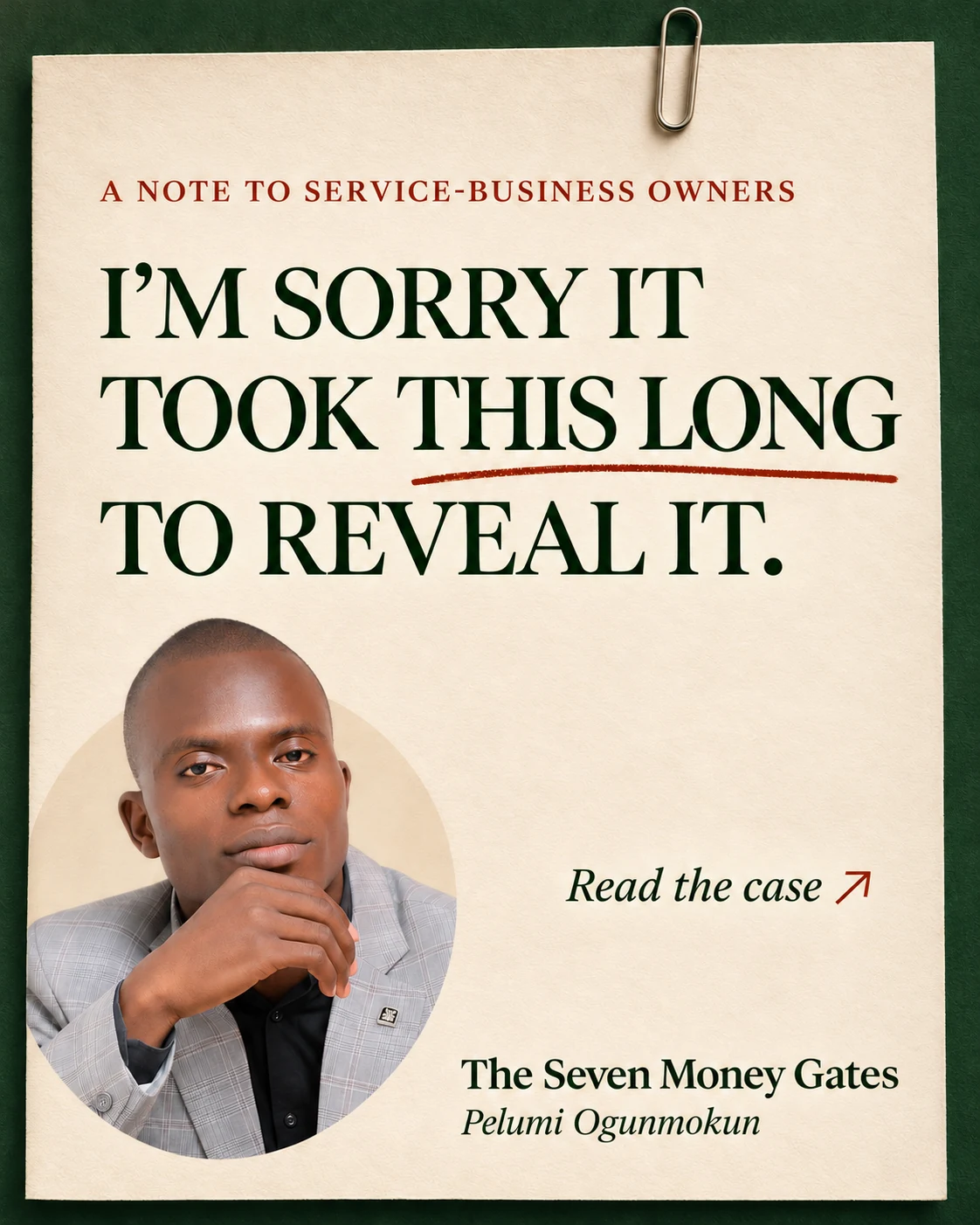
My name is Pelumi Ogunmokun. I created The Seven Money Gates, and I have been tracing how money enters businesses like Apple, Netflix and Costco.
With one objective: to follow how money actually changes hands across different kinds and sizes of business.
From the roadside pepper seller in Mile 12, to consultants and agency owners here in Nigeria, all the way to billion-dollar companies people recognise around the world.
Different businesses. Different sizes. The Seven Money Gates at work.
That was the foundation of the book. But as I traced the applications, one decision kept drawing me back to something much closer to home.
Our own proposals.
I already knew this gate before I saw PalmPay using it. Seeing it there made me recognise the same gate at work in fintech too.
Then I brought the question back to my own business:
What is a client already worried about that we could make a clear, valuable commitment around?
Think about the moment someone asks you, “How much?”
You already have the work. You know how to deliver it. The client is already considering it.
But the client is also thinking about what happens if the result doesn't follow, or if too much of the uncertainty is still left with them.
What happens when you make that commitment visible as a choice in the offer?
That was the part I wanted to test for myself.
So when an active client opportunity came, I changed one packaging decision in the proposal.
We presented two options for the same core scope of work. Both required an initial cash deposit.
One carried a different guarantee and payment structure. Its required upfront commitment was nearly twice that of the standard option. The total deal value was seven figures higher.
The client still chose it—and paid a cash deposit.
We had not created another service, hired another team or changed the core work we were delivering. We had made a different commercial commitment around it—and the client chose to pay for that arrangement.
You can see why this application interested me so much.
When the offer, the prospective client and the delivery system already exist, this is a decision you can make in the next proposal you send.
That is what I waited to prove in my own business.
What was the client really choosing?
Every service contains a promise.
Someone pays you because they expect something to happen. A problem solved. Something made easier. A business moved forward. The work matters because of what they expect it to do for them.
But a promise has to pass through real life.
People delay. Circumstances change. Something that worked in one situation behaves differently in another. You can plan the work carefully and still meet conditions you do not fully control.
And your client knows this. They may have paid for a service before and been left wondering what happened to the result they thought they were buying.
So when they look at your proposal, there is another question behind “How much?”
What happens to my money if this does not work the way I hope it will?
You can explain your process, show your past work and make the promise clearer. But the uncertainty still needs somewhere to sit. What will the client carry? What are you prepared to take responsibility for?
That was the decision inside our own proposal.
Both options required an initial cash deposit. Both covered the same core work. The higher-value option carried a different guarantee and performance-linked payment arrangement.
It asked for nearly twice the upfront commitment. The two options were also seven figures apart in total deal value.
The client still chose the higher-value option—and paid a cash deposit.
The price had gone up. So had what they were being asked to commit at the beginning. What made the choice worth considering was the responsibility we agreed to carry around the promise.
More of our compensation depended on what actually happened. We were putting more of our own fee at risk around work we had already agreed to do.
The service was one part of the offer. The protection around its promise was another. That is the Risk Gate at work.
Why the decision can happen quickly
We already had a service to deliver, an active client opportunity and a proposed scope. The choice could be presented in the proposal we were already preparing.
We had not created another service, hired another team or added a longer list of tasks. We changed the commitment around the work and how the client would pay for it.
That is what makes this application worth looking at when you already have an offer, a delivery system and people considering it. You can examine the choice before building an entirely new audience or product.
Look at the promise inside your next proposal.
What is the client worried will happen—and what meaningful part of that uncertainty can your business genuinely take responsibility for?
That is where I would begin. A clear commitment the client values, with conditions both sides understand and a promise your business can honour.
Bring a real opportunity to the field study
Before the book is finalised, I am selecting five qualifying Nigerian consultants or service businesses with active client opportunities for a free 14-day field sprint.
We will look at the offer you already have, the uncertainty your client is carrying and the commitment you can support. Then we will work through how to make that choice clear in your next deal.
If a proposal is about to go out, bring that situation. The application page explains the field study and asks for the context needed to assess fit.
Sources and context
Based on Pelumi Ogunmokun’s firsthand account of the proposals, the client’s accepted agreement and a cash deposit. The seven-figure comparison is the difference in total deal value.