A customer can look at a subscription and ask a very simple question.
What am I still getting from this?
The business collecting the payment needs an answer that remains useful after the original reason for joining.
That is one way to look at Amazon's Alexa+ decision.
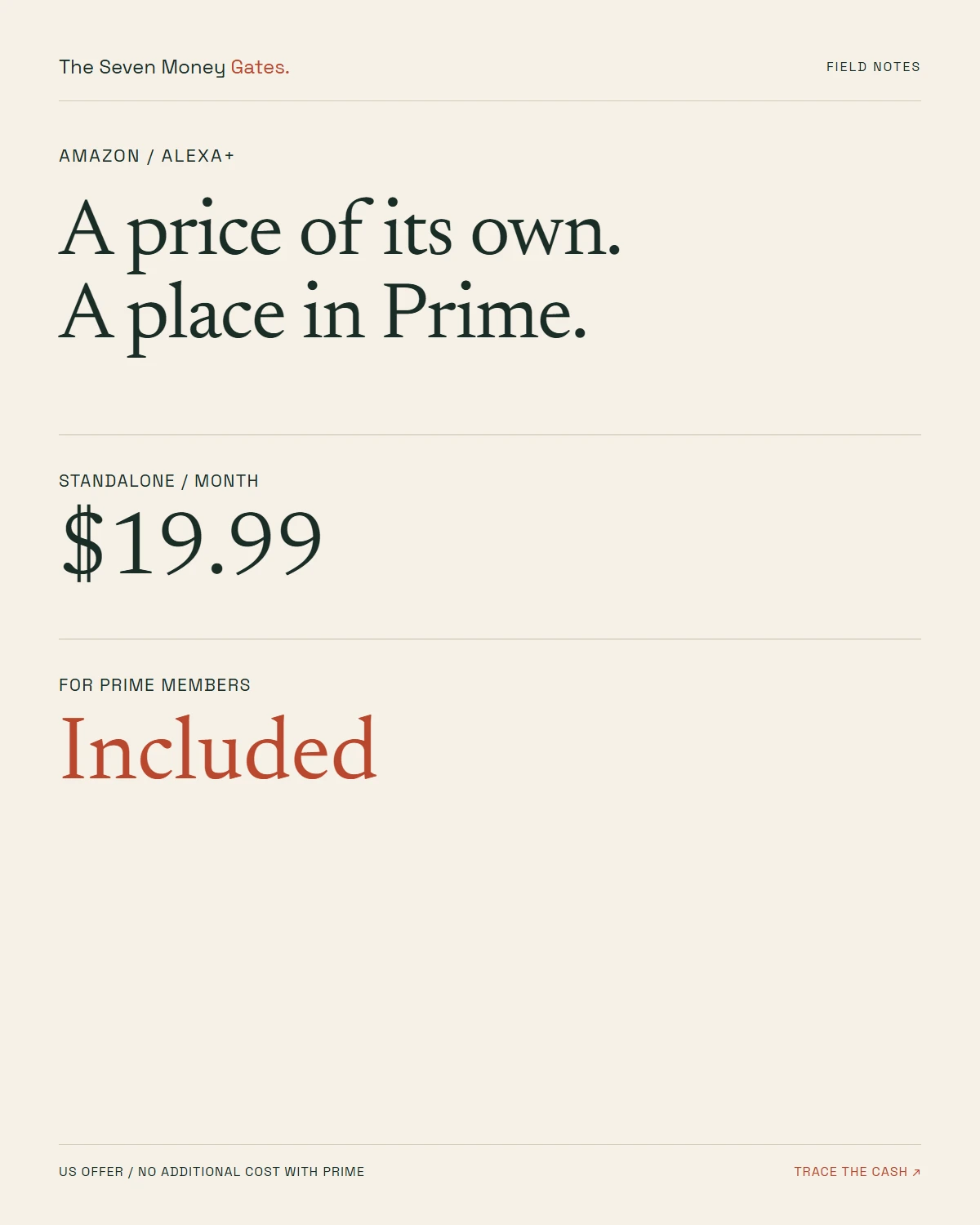
In its US offer, Amazon lists the full Alexa+ experience at $19.99 a month for customers without Prime. Prime members receive it at no additional cost.
There is also a limited free chat option for non-members.
One capability. Different ways to reach it.
What changes when that capability becomes part of a relationship the customer already pays to keep?
The offer can reach beyond the new subscription.
The familiar way to think about launching a paid tool is to count the people who might subscribe to it.
How many want it?
What will they pay?
How much will it cost to serve them?
Those questions still matter.
But a capability can also have value inside another paid offer.
For a Prime member who finds Alexa+ useful, it becomes part of what the membership provides.
For someone considering the standalone subscription, inclusion can become another feature to weigh when comparing the options.
That gives the business more than one commercial question to examine.
The value may show up in a new subscription. It may also show up in whether a wider bundle feels worth keeping.
The offer makes that possibility visible. Its actual effect on customer behaviour needs to be measured.
The payment buys continuing access.
Through The Seven Money Gates, the Access Gate helps explain this arrangement.
A customer can buy a device and keep the physical object.
Continuing access to a capability around it can have its own terms.
That access may be sold alone. It may be included in a larger membership.
Bundling changes the offer around the gate.
It gives us a useful question to bring into a smaller business.
What could your existing relationship help the customer keep doing?
Start with the reason they come back.
Imagine an operations adviser who helps small manufacturers improve their production planning.
An initial engagement helps a client put a workable process in place.
Afterwards, the client's needs continue. New staff join. Suppliers change. Different orders create different planning problems.
The adviser keeps building useful templates, worked examples and decision tools.
She could sell another consulting engagement whenever the client needs substantial help.
She could also test a membership that gives clients continuing access to the resource library as it develops.
If she later adds a useful planning tool, there are several choices.
Sell access separately.
Include it in the membership.
Offer different access levels for different needs.
The decision should follow what clients actually use and value.
The client still needs a reason to renew when the original project is no longer fresh in their mind.
A resource that helps them solve a recurring problem can provide one.
This is an imagined illustration. It shows the commercial question, rather than a reported result.
Useful inclusion is a design decision.
Adding more items to an offer is easy.
Making the items useful together takes a better understanding of the customer.
A business can keep expanding a membership until it becomes a list that sounds impressive and is difficult to explain.
The practical test is simpler.
Which part does the customer return to?
Which part helps them get more value from the rest?
What would they miss if they stopped having access?
Those answers are more useful than the number of bonuses on a sales page.
Look at the relationship around the capability.
Alexa+ has a price of its own. Amazon also chose to place the full experience inside Prime for members in the US.
That is a decision worth tracing.
A useful capability can be designed to earn on its own and to support a larger paid relationship.
Look at the business you already have.
What do customers keep needing after the first thing they bought from you?
And could a well-designed Access offer give them a reason to keep the relationship?
Explore the wider Money Gate map ↗
Sources and context
The story describes the US offer checked on 13 November 2026. Prime is a paid membership, and the free non-Prime chat tier is limited. The operations adviser is an imagined illustration. The discussion of membership value is Pelumi’s analysis, not a measured retention result.