You buy a ring.
It comes home with you. You put it on your finger.
Ownership is easy to picture because the object is right there.
Now put a membership beside that purchase.
What is the second payment for?
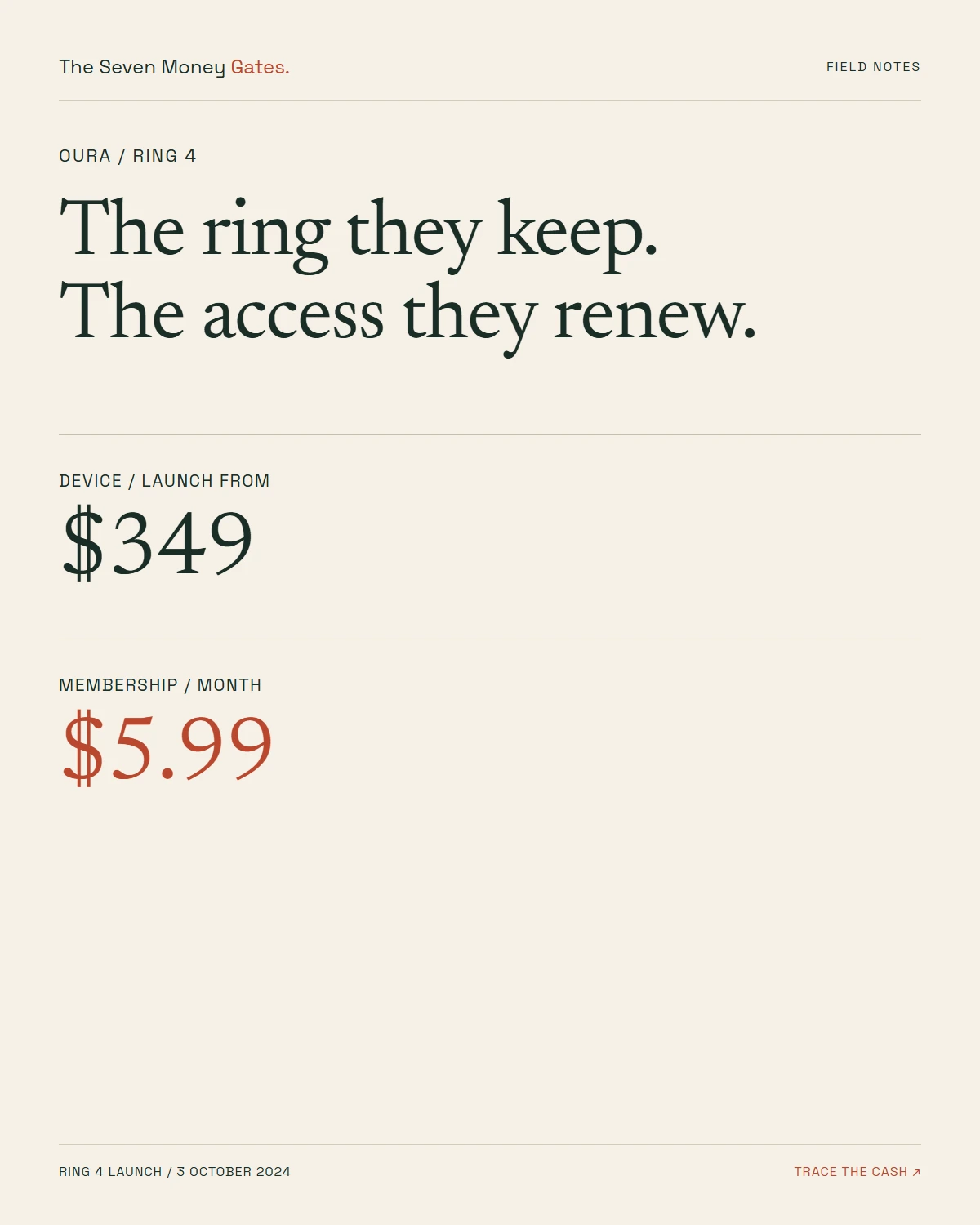
Oura's Ring 4 launch on 3 October 2024 put two prices in the same announcement: the ring started at $349, and membership was listed at $5.99 a month or $69.99 a year.
The device and the membership appeared together.
To understand the business, we need to follow both arrangements.
The customer's need can continue after the sale.
A physical purchase has a visible moment of completion.
The customer pays. The object changes hands.
But some objects are part of a continuing activity.
The customer uses them repeatedly. Information changes. Their own situation changes. There can be something new to interpret each time they return.
Oura's launch paired the ring with its app and membership experience around personal data and insights.
That is a useful commercial structure to examine without making the story a claim about any health outcome.
The customer can keep the physical product while the continuing digital experience has a membership around it.
The first sale and the ongoing arrangement serve connected needs.
They are still worth tracing separately.
Products and Access can work together.
The Seven Money Gates makes that distinction easy to see.
There is a physical product the customer buys.
There is continuing access offered through a membership.
The product can make that access useful in a particular way. The access can help give meaning to the customer's continuing use of the product.
The relationship between them is part of the offer design.
For a business owner, this opens a question that reaches beyond wearable devices.
What does your customer keep trying to understand or use after the first purchase?
The handover may be the beginning of another need.
Imagine a consultant who helps a business assess its customer experience.
The engagement produces useful findings and a set of changes.
The business acts on them.
Then the circumstances move. A new branch opens. New employees join. The buying journey changes. The owner wants to know whether the improvements are holding up.
There may be a reason to commission another assessment.
There may also be value in continuing access to a well-maintained library of review tools, examples and measurement templates the team can use itself.
Those are different ways to serve the need after the first engagement.
The consultant would need to decide what is provided, what stays current and what support belongs in the arrangement.
The client would need to see why returning is useful.
This is an imagined example. It illustrates the question rather than assuming every consulting business should launch a membership.
A recurring payment needs a recurring reason.
The calendar does not create the value.
It is possible to look at a membership and see only the frequency of payment.
Monthly.
Annually.
But that describes when the customer pays.
The deeper question is what they are paying to keep using.
If the need ends after one delivery, putting a monthly price on it does not make the customer's reason to stay stronger.
If the need continues, the business can examine an offer built around that continuation.
That is why the customer's actual use matters.
What do they return for?
What changes often enough to need attention?
What would they lose access to if the membership ended?
The answers help define the offer before the billing rhythm is chosen.
Follow what happens after ownership.
Oura's launch makes two arrangements visible around a familiar object.
A ring the customer buys.
A membership around the continuing experience.
The lesson is useful even if your business will never manufacture a ring.
Look beyond the moment you hand over the work or the product.
Your customer may still have a problem to solve, a resource to use or a result to understand.
What would a useful offer for that next need look like?
Explore the wider Money Gate map ↗
Sources and context
Prices are the Ring 4 launch prices in the announcement dated 3 October 2024, not a claim about every current product or region. This is a business-model analysis, not a claim of medical effectiveness. The customer-experience consultant is an imagined example.