A customer opens a chat window.
They ask a question. The assistant responds.
From the outside, it can look like the same activity happening again and again: a conversation with a piece of software.
But the company buying that software may be looking for something much more specific.
Get this support problem out of the queue.
Find out whether this prospect is a fit.
Send the right person to the right next step.
The conversation matters because of what it does.
So what should the software company charge for?
Intercom put a definition around the outcome.
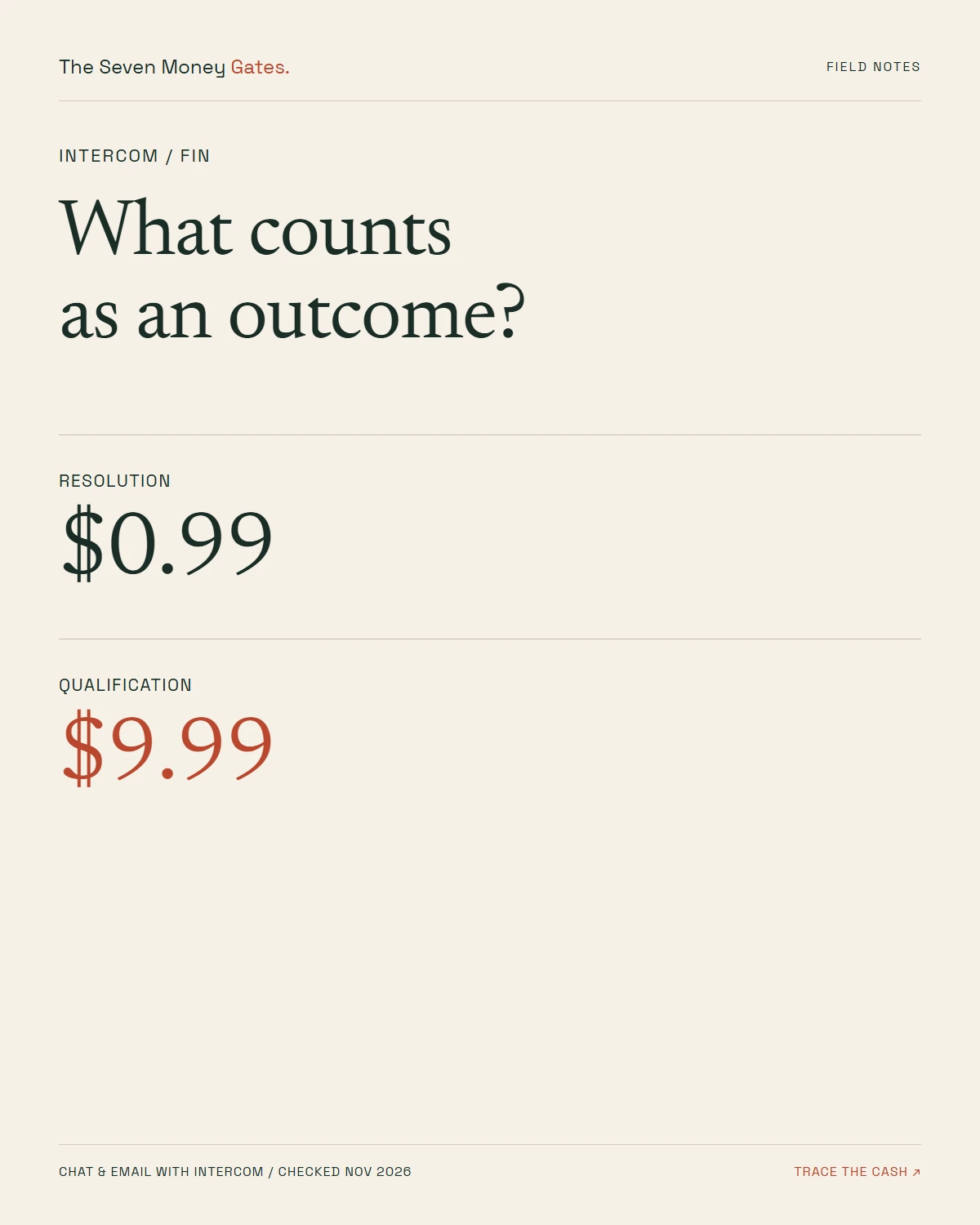
Intercom's Fin documentation, dated 23 September 2026, lists different billable outcomes for chat and email used with Intercom.
A resolution is listed at $0.99. A qualification is listed at $9.99.
The outcome depends on the defined event. A resolution can be counted when no further help is requested after Fin's last answer. A qualification involves matching a prospect to the customer's criteria and routing them accordingly.
The pricing makes a useful commercial question visible.
What has happened that the buyer is willing to count as a unit of value?
You can call the interaction a conversation. The buyer may call it a support issue handled or a suitable prospect routed.
Those descriptions lead the buyer to look at the offer differently.
What are you asking the customer to count?
Many service proposals describe activity very clearly.
A number of hours.
A number of calls.
A number of reports.
Those can be sensible ways to scope work and protect delivery capacity.
But a buyer can understand every item on the list and still wonder what the work will change.
If you sell a report, what decision should it help them make?
If you sell a series of calls, what should they be able to do afterwards?
If you handle enquiries, what should happen to an enquiry before your responsibility is complete?
Intercom's example is useful because the word “outcome” has a working definition behind it.
The buyer and provider need to know which event counts.
Otherwise, one person can believe the work is finished while the other believes nothing useful has happened.
Follow the work, then the billing unit.
Through The Seven Money Gates, we can examine the service being performed and the way its price is measured.
Fin carries out defined work in a conversation. Its outcome rules determine when a charge is counted.
A change in billing unit can make that service easier to compare with the job the buyer wants done.
We still need to examine the actual promise to understand whether the provider has taken on any additional risk.
A fee per outcome, a guarantee and a commitment to carry a loss each deserve their own explanation.
That distinction becomes practical when you design your own offer.
What does “finished” mean in your business?
Imagine a recruitment specialist who helps a firm fill a difficult role.
The firm wants a suitable employee to start work. The specialist may control only some of the steps on the way there.
Finding candidates. Checking the agreed criteria. Presenting a shortlist. Coordinating interviews.
There is room for confusion if the proposal simply promises “recruitment support.”
A clearer offer could define a qualified shortlist: how many people, which criteria they must meet, what checks have been completed and what evidence the client receives.
That does not make a shortlist the same thing as a successful hire.
It makes the particular service and its completion easier to understand.
The specialist can then decide whether a separate commitment around placement or replacement belongs in the offer.
This is an imagined example. The useful question is real.
What event does your customer care about, and which part can your business reliably deliver?
A result needs a definition.
“More value” can sound persuasive and still leave the customer with very little to evaluate.
A defined result gives them something to examine.
It also gives your team a clearer idea of what must happen before the work is complete.
That is the decision worth tracing here.
Look at your next proposal through the customer's eyes.
When they reach the price, can they connect it to something they want to happen?
And if they agree to pay, will both of you recognise the moment you have delivered it?
Explore the wider Money Gate map ↗
Sources and context
The prices refer to Fin over chat and email used with Intercom, checked on 13 November 2026. Other outcomes, channel prices and platform charges also exist. The recruitment specialist is an imagined example. The gate analysis is Pelumi’s interpretation.