An airline needs an engine to work.
Buying it is one commercial decision.
Keeping it available, planning the maintenance and dealing with future repair costs create more decisions around the same engine.
Those needs do not disappear after delivery.
They become part of operating the business.
So what can an engine company offer around the product it already makes?
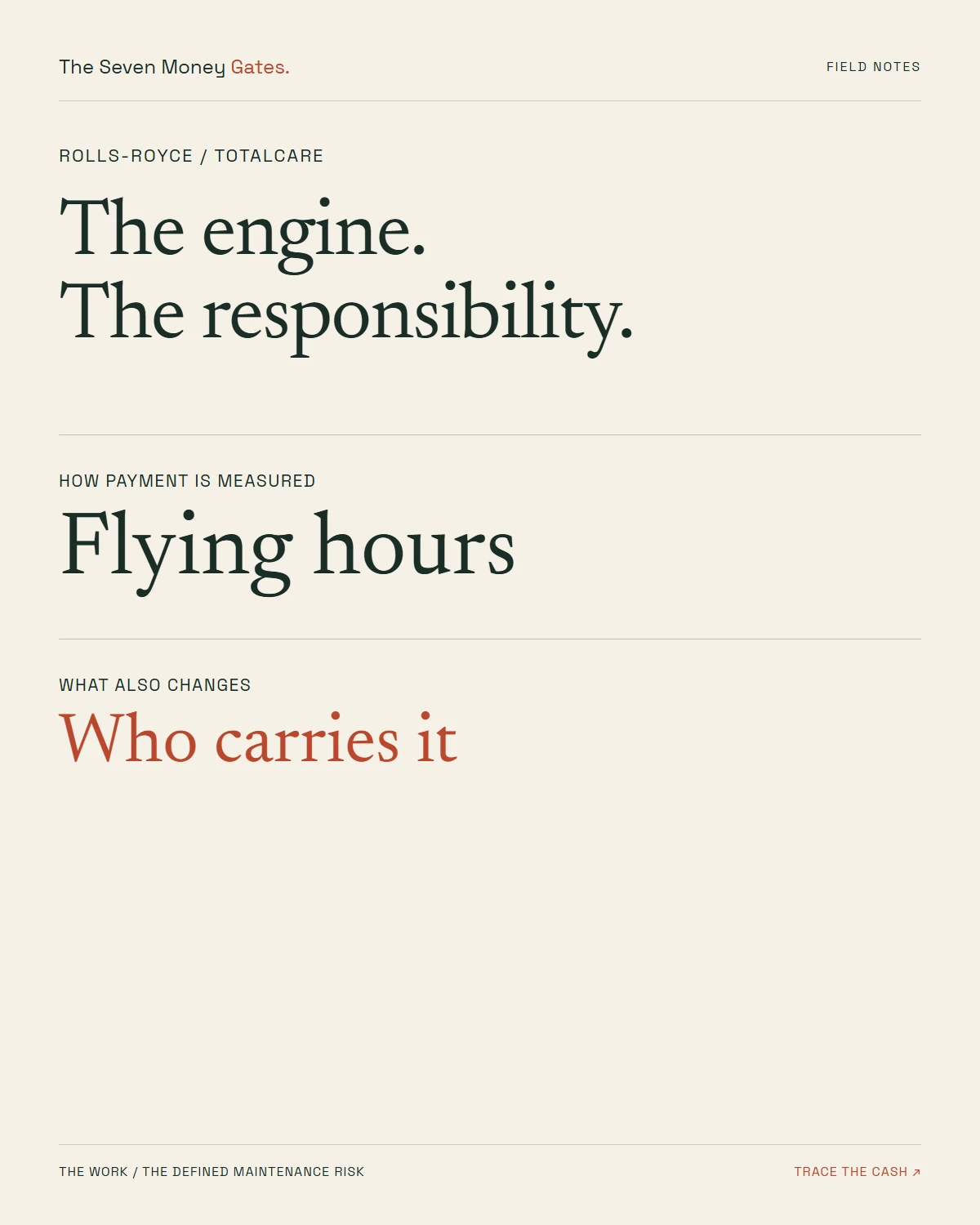
Rolls-Royce's TotalCare is worth examining because its own description makes the responsibility visible.
Look at what the arrangement carries.
Rolls-Royce describes TotalCare as a risk-transfer service.
Its offer includes defined maintenance activities and transfers time-on-wing and shop-visit cost risks back to Rolls-Royce. The charging mechanism is expressed per engine flying hour.
That puts two decisions beside each other.
How the payment is measured.
And which future maintenance responsibilities the provider carries.
The flying hour helps explain the payment mechanism.
The risk commitment helps explain another part of what the customer is buying.
The customer has a concern beyond the repair task.
A maintenance provider can sell work when it is needed.
A customer may also want a clearer arrangement around the cost of that work over time.
Those are connected needs, but they are worth examining separately.
One concerns the activity.
Another concerns exposure to an uncertain future cost.
Through The Seven Money Gates, we can see Services and Risk working together around the engine.
The provider has to design the operation that supports the commitment.
Knowing the equipment, monitoring it, planning maintenance and managing repairs all become commercially important when responsibility comes back to the provider.
The promise needs an operating system behind it.
The uncertainty may already be in your customer's questions.
Service professionals hear versions of this problem every day.
What happens if it fails again?
What if we need another repair?
How much will we be left paying?
A customer may ask those questions while the proposal keeps describing the quality of the initial work.
There may be an opportunity to design a clearer commitment around a particular concern.
The useful first step is to identify exactly which uncertainty matters.
Then decide whether you can carry it, what carrying it would require and how the arrangement would be priced.
Consider the equipment around a smaller business.
Imagine a specialist maintaining refrigeration equipment for food shops.
The shop owner needs the equipment to work. The owner also worries about facing a large repair bill at an awkward time.
A basic arrangement could pay for each inspection and repair as it happens.
A different offer could include a defined set of repair costs for specified equipment over an agreed period.
The provider would need to inspect the equipment, define covered parts, understand likely costs and set clear terms around the commitment.
The customer would need to know what is covered and what remains their responsibility.
This is an imagined illustration.
It shows why the design involves more than changing a one-off invoice into a monthly one.
The responsibility carried has changed.
Price and responsibility need to fit together.
A provider can make a bigger promise than its systems can support.
It can also quietly absorb responsibility without recognising that the customer values it.
Both deserve attention.
A well-designed commitment asks what can go wrong, which part is being carried and what it costs to honour that agreement.
That is useful work for anyone trying to build a stronger service offer.
It starts with the concern the customer has already expressed.
The payment rhythm comes later.
Follow the engine beyond delivery.
Rolls-Royce's TotalCare gives us a visible example of a larger commercial architecture around a familiar product.
There is the engine.
There is the work required to maintain it.
There is an agreement around defined future maintenance risks.
The flying hour is one part of that design.
Look at the service your own business provides.
What future uncertainty is the customer still carrying after they pay for the work?
And could your business responsibly make a useful offer around it?
Explore the wider Money Gate map ↗
Sources and context
The story concerns defined engine-maintenance responsibilities in TotalCare, not all aviation losses or an unlimited insurance promise. The refrigeration provider is an imagined illustration. The distinction between the payment unit and the responsibility carried is Pelumi’s framework analysis.