Walmart already knew how to sell televisions.
So on 3 December 2024, when it completed the purchase of VIZIO in a deal valued at approximately $2.3 billion, there was a more interesting question than how many more televisions it could sell.
What else was inside that television company?
Because the familiar answer is easy.
A television company makes televisions. People buy them. The company makes money from the difference between what the product costs and what the customer pays.
You sell a product.
That explanation follows the television from the factory to the shop and into someone's home.
Then it stops.
But the customer has only just switched it on.
The sale ended. Another relationship continued.
Think about what you see when you look at a television.
A screen. A remote. Something you use to watch a film, follow the news or keep up with a match.
Now think about what another business might see.
People gathered around a screen. Their attention held by something they chose to watch. An opportunity to put a relevant offer in front of them.
The first person wants entertainment.
The second wants to reach the person being entertained.
Those are two different customers. They want two different things. And there can be a payment attached to each.
VIZIO had built a business around that second relationship through its SmartCast platform and advertising operation. Walmart's completion announcement specifically connected the acquisition to growth in Walmart Connect, its advertising business.
The television was the part most people could point at.
The other business was easier to miss.
Then look at the accounts.
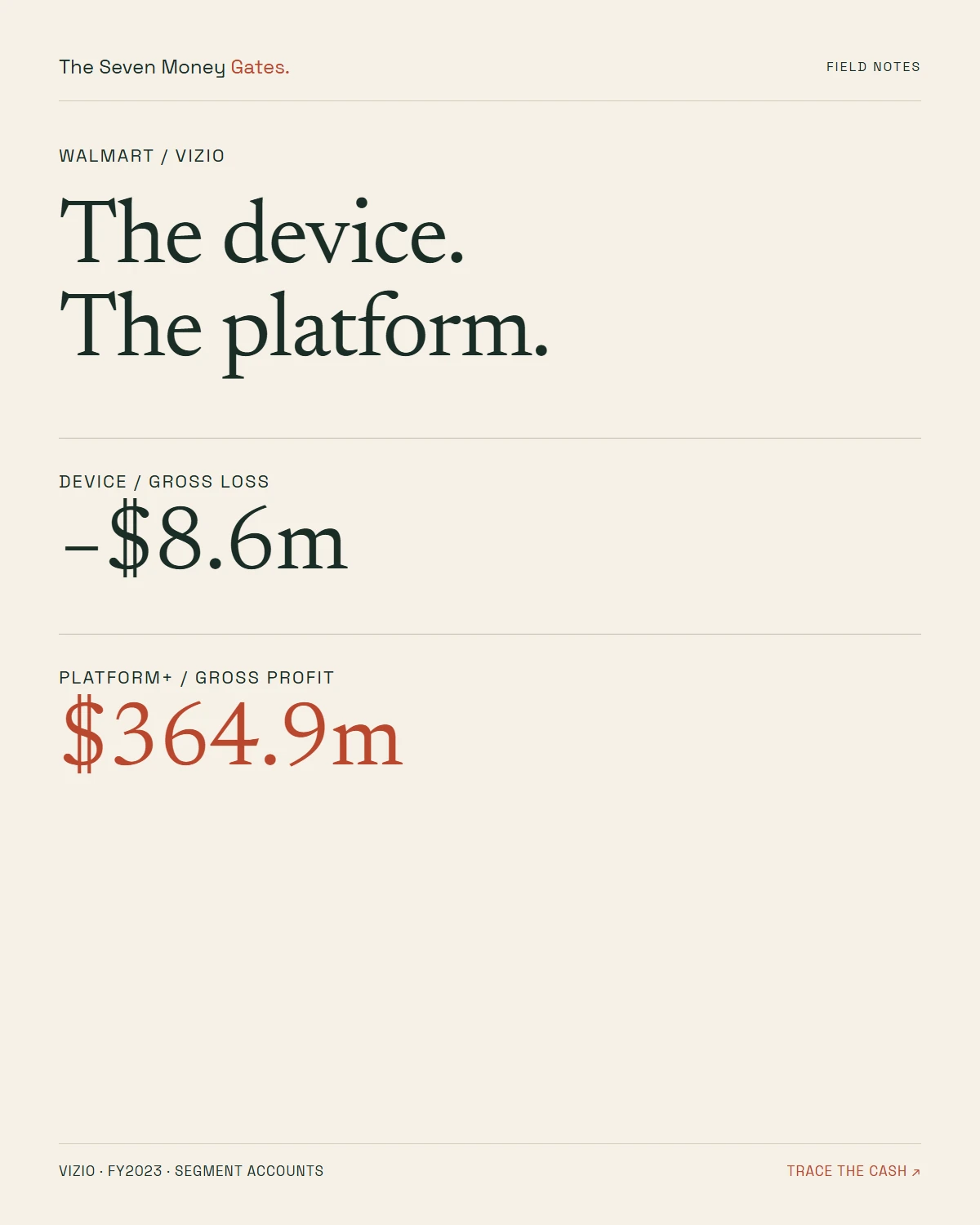
In 2023, VIZIO's Device segment recorded a gross loss of $8.6 million.
Its Platform+ segment recorded gross profit of $364.9 million.
Platform+ included advertising, alongside activities such as data licensing and content distribution. The figures sit side by side in VIZIO's annual filing.
Read that again with the familiar answer in mind: a television company makes its money selling televisions.
There was an entire commercial structure around the product that this answer would leave out.
And that is where the story becomes useful beyond televisions.
If you only ask what a business sells at the counter, you can miss what it has arranged to sell after the first customer has walked away.
You might study the product. Improve the product. Compare its price with the next product.
All while another company is asking who else could find value in the relationship that product creates.
Follow the person making the next payment.
This is one reason I use The Seven Money Gates to trace a business.
Start with what is familiar. Then keep following the cash.
The customer who buys the television is paying for a product.
An advertiser paying to reach viewers is buying attention.
Different buyer. Different exchange. Another Money Gate in use around a familiar business.
The television does not have to stop being a television for that to happen.
And the business does not have to abandon the first thing it sells before it can recognise value somewhere else.
That is the possibility I want business owners to notice.
Because the question can follow you into your own business.
Who else could find value in what your existing work brings together?
You do not need to sell televisions to ask that question.
Imagine an adviser who works with independent dental practices.
Over time, she starts a useful briefing for practice owners. They read it because it helps them make better decisions. They ask questions. They share the problems they are trying to solve.
She may see the briefing only as a way to find her next advisory client.
But consider a supplier with a useful product for those same practices.
It may already be spending money trying to reach the people who read her briefing.
The adviser and the supplier are looking at the same group of people from different sides.
For her, they are people she helps and may work with.
For the supplier, they could be the right audience for a relevant offer.
That creates a question worth testing: would the supplier pay for a clearly disclosed placement in a briefing those owners already value?
The answer depends on the audience, the offer and whether the placement earns its place there. Trust is part of what makes the relationship valuable. A careless sponsor can damage it.
But notice what changed before she needed a new product or a larger team.
She stopped looking at the briefing only as a route to selling her own service.
She considered another buyer and another exchange around something her work had already brought together.
That is an imagined example. The commercial question is one a real specialist can test.
What else is inside the business you already have?
You can look at Walmart and VIZIO and see a deal far beyond your budget.
Or you can look at the decision and ask a question within your reach.
What does your work bring together that you have only learned to value in one way?
An audience. A useful resource. A method. A continuing need after the original purchase. An uncertainty your customer wishes someone would carry.
Each deserves a closer look at who might pay, what they would receive and what you would need to put in place.
That is the work of tracing the gates.
The familiar offer is where you begin. Keep looking at the relationships around it.
There may be another customer you have never thought to make an offer to.
Explore how the Money Gates work across the full brand collection ↗
Sources and context
The acquisition is a historical December 2024 event. The financial comparison uses VIZIO’s 2023 segment gross profit, including activities beyond advertising in Platform+. The dental adviser is an imagined example. The gate mapping is Pelumi’s analysis.